What a star is worth
Published
A card carries one to five stars. The question is what a star actually buys. We counted it, card by card, in the game’s own card file.
How we counted
Every figure below comes from a script run over the client’s card file. For each card we add up its four sides, with A counting as 10. That sum does not tell the whole story: it ignores where each number sits, and it means nothing under Plus or Same, where matches are what count. What it does give is a plain measure of what a card holds up against the rest of the board in a match with no special rules.
The two sets are counted separately, because they do not follow the same scale.
Two scales that look alike
On average, one more star is worth between 2.2 and 5.5 points of sum. On the Final Fantasy XIV side, the mean goes from 13.4 at one star to 18.5, then 21.8, 25.9 and 28.1 at five stars. On the Final Fantasy VIII side, it goes from 14.1 to 19.5, 23.0, 25.3 and then 27.6.
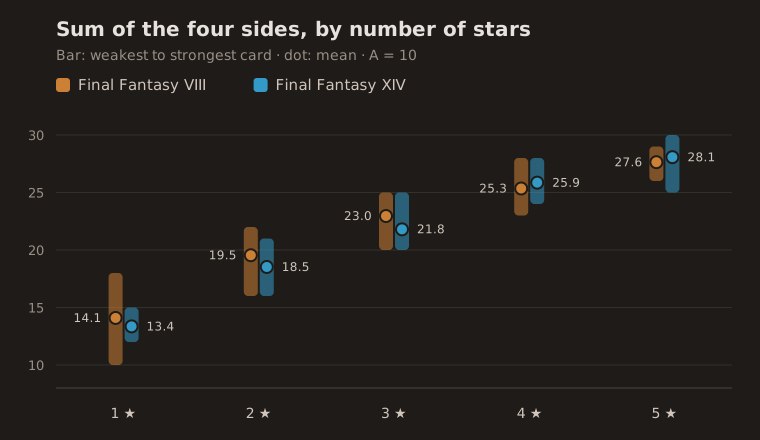
Similar means, very different spreads: Final Fantasy VIII sprawls, Final Fantasy XIV keeps tight.
The means are close; the spreads are not. Final Fantasy XIV’s one-star cards all sit between 12 and 15. Final Fantasy VIII’s run from 10 to 18, and over a third of them (36%) match or beat the weakest two-star card.
The reason is the conversion. Final Fantasy VIII sorts its cards into ten levels, not five stars. In Triple Triad Online, levels 1 to 3 become one star, 4 and 5 two stars, 6 and 7 three stars, 8 and 9 four stars, and level 10 five stars. A Final Fantasy VIII star can therefore hold up to three of the original tiers, and what used to separate them now sits inside a single star.
The fifth star buys an A
Final Fantasy XIV’s surprise lies between four and five stars. 87% of its four-star cards have a sum at least equal to that of the weakest five-star card. Sixteen of them reach 28, Sephirot, Barbariccia and Eald’narche among them; the weakest five-star, Varis yae Galvus, stops at 25.
What the fifth star adds is the A. In this set, no card from one to four stars has one. At five stars, 84% of cards carry at least one A, and fifteen carry two. The price is paid elsewhere: 23% of five-stars have a 1 somewhere, and their weakest side averages 3.2, against 3.3 for the four-stars.
Final Fantasy VIII hands out its aces differently. The A turns up as early as two stars, on a single card (Pupu), then on almost half the four-stars (48%) and on every five-star. None of the latter has a 1.
Two aces side by side
A lone A can be worked around. Two A on neighbouring sides make a corner that nothing takes in a match without special rules: played in the corner that faces away from them, the card shows only its two aces.
Nine Final Fantasy XIV five-stars have that shape, among them Varis yae Galvus (A, A, 4, 1), Terra Branford and Bartz Klauser. On the Final Fantasy VIII side there are only two: Doomtrain at four stars, Edea at five. Varis and Edea are, as it happens, among the weakest five-stars of their set by sum: their points are gathered on two neighbouring sides rather than spread out.
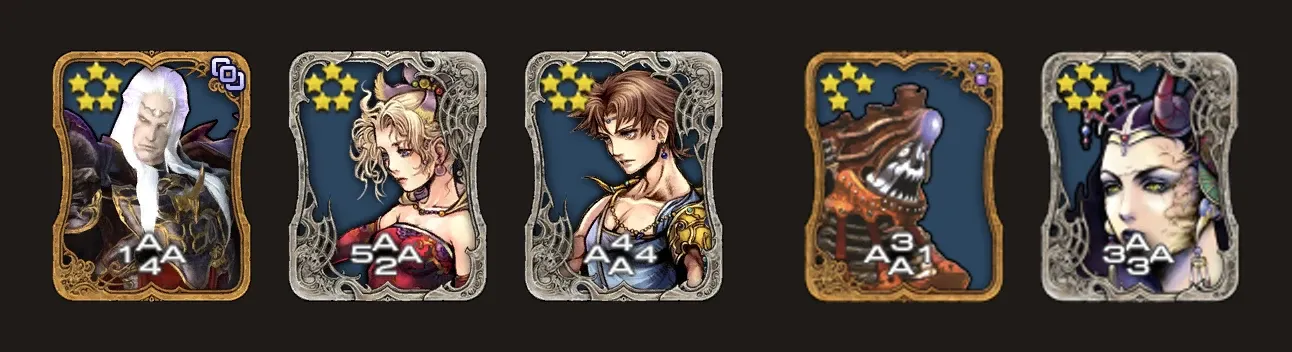
Varis yae Galvus, Terra Branford and Bartz Klauser (Final Fantasy XIV), then Doomtrain and Edea (Final Fantasy VIII): two aces that touch, and a corner nobody takes.
The most common number
Across all sides, 7 is Final Fantasy XIV’s most frequent number (17.4% of sides), followed by 6 (14.3%). Final Fantasy VIII is flatter: its most common number, 4, covers only 13.3% of sides, and 2s are clearly more frequent there (10.6% against 7.9%).
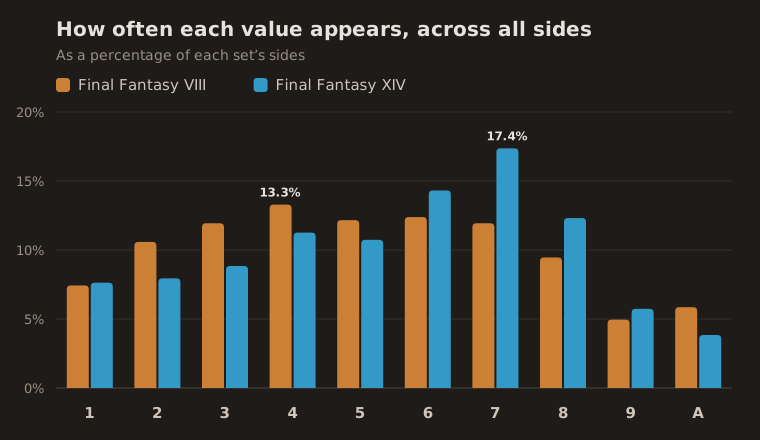
Final Fantasy XIV leans towards 7; Final Fantasy VIII spreads more evenly, and keeps more aces.
What this means for Same: draw two sides at random from Final Fantasy XIV and they are equal 11.5% of the time, and more than one of those matches in four (26%) is a 7 against a 7. In Final Fantasy VIII, matches are barely less frequent (10.8%) and 4 against 4 is the most common one (16%).
What to take away
An extra star guarantees a higher average, not a stronger card. In Final Fantasy XIV, the fifth star pays for an A, sometimes at the cost of a 1. In Final Fantasy VIII, the star reflects an old level, and two cards of the same rank can be far apart.
Each card’s details are in the game; the rules that change this arithmetic, from Same to Reverse, are on the rules page.