From Balamb to the Gold Saucer: twenty-seven years of Triple Triad
Published
Triple Triad began as a sideline in Final Fantasy VIII. Twenty-seven years on, it has changed consoles, games, rules and even devices. Here is what moved, and what stayed put.
1999: a game within the game
Final Fantasy VIII came out on the PlayStation on 11 February 1999 in Japan, in September in North America, and on 27 October in Europe. Triple Triad is a mini-game there, but one you meet everywhere: many of the characters you cross paths with will take you on, and the cards you win have uses away from the board as well.
The board is already the one you know: three squares by three, five cards each, four numbers per card, A at the top. This first version has seven special rules: Open, Same, Same Wall, Plus, Random, Sudden Death and Elemental. Combo is not one of them; it is what automatically follows a capture by Same, Same Wall or Plus.
Two mechanisms belong to that game alone. The first is the stake: a trade rule decides what the winner takes home, from a single card (One) to the loser’s whole hand (All). The second is geography: each region has its own rules, and a player who travels can carry them from one region to the next, or get one abolished locally. The rules of a match therefore depend on where you are playing, and on where you have come from.
The re-releases
The Windows version arrived in 2000. The game came back on Steam on 5 December 2013, then as a Remastered edition on 3 September 2019 on PlayStation 4, Xbox One, Nintendo Switch and PC, before reaching phones in 2021.
For Triple Triad, these re-releases change little on the board. The Remastered edition mostly retouches the look of the cards: the Guardian Force cards now show the whole creature rather than a close-up.

The same Squall, twice: the Final Fantasy VIII set’s card and the Final Fantasy XIV set’s, as Triple Triad Online shows them.
2015: Eorzea’s Gold Saucer
The real second start came in Final Fantasy XIV. Patch 2.51, in February 2015, opened the Manderville Gold Saucer, and Triple Triad moved in with 80 cards. You face characters scattered across the world and take part in tournaments, and winnings are counted in MGP, the park’s currency.
Cards swap levels for stars, one to five, and a deck cannot field as many as it likes: two cards of four stars or more at most, and only one of them at five stars.
The rule list changes even more. Final Fantasy XIV keeps Open (as All Open), Same, Plus, Random and Sudden Death, but leaves out Same Wall and Elemental. It adds Three Open, Order, Chaos, Reverse, Fallen Ace, Ascension, Descension and Swap, along with Roulette, which draws other rules at random. Draft, in which you build your deck from sets of cards offered to you, arrived with Patch 5.4 in December 2020. The trade rules, and their spread from region to region, did not make the journey.
In your pocket
The same year, Square Enix put Triple Triad in its Final Fantasy Portal App, on iOS and Android: in April 2015 in Japan, in August everywhere else. The service closed in November 2024. Cards shared with Final Fantasy XIV had been announced; we found no sign that they were ever switched on.
What remains
From one version to the next, the core has not changed: nine squares, ten cards, one number against another, and the majority at the end. What changes is the rules around it, the economy of the cards, and what you stand to lose.
Triple Triad Online brings both lines together: Final Fantasy XIV’s rules for the board and the hand, plus Same Wall and Elemental from Final Fantasy VIII, with a format for each set and a third where everything is allowed. The full list is on the rules page.
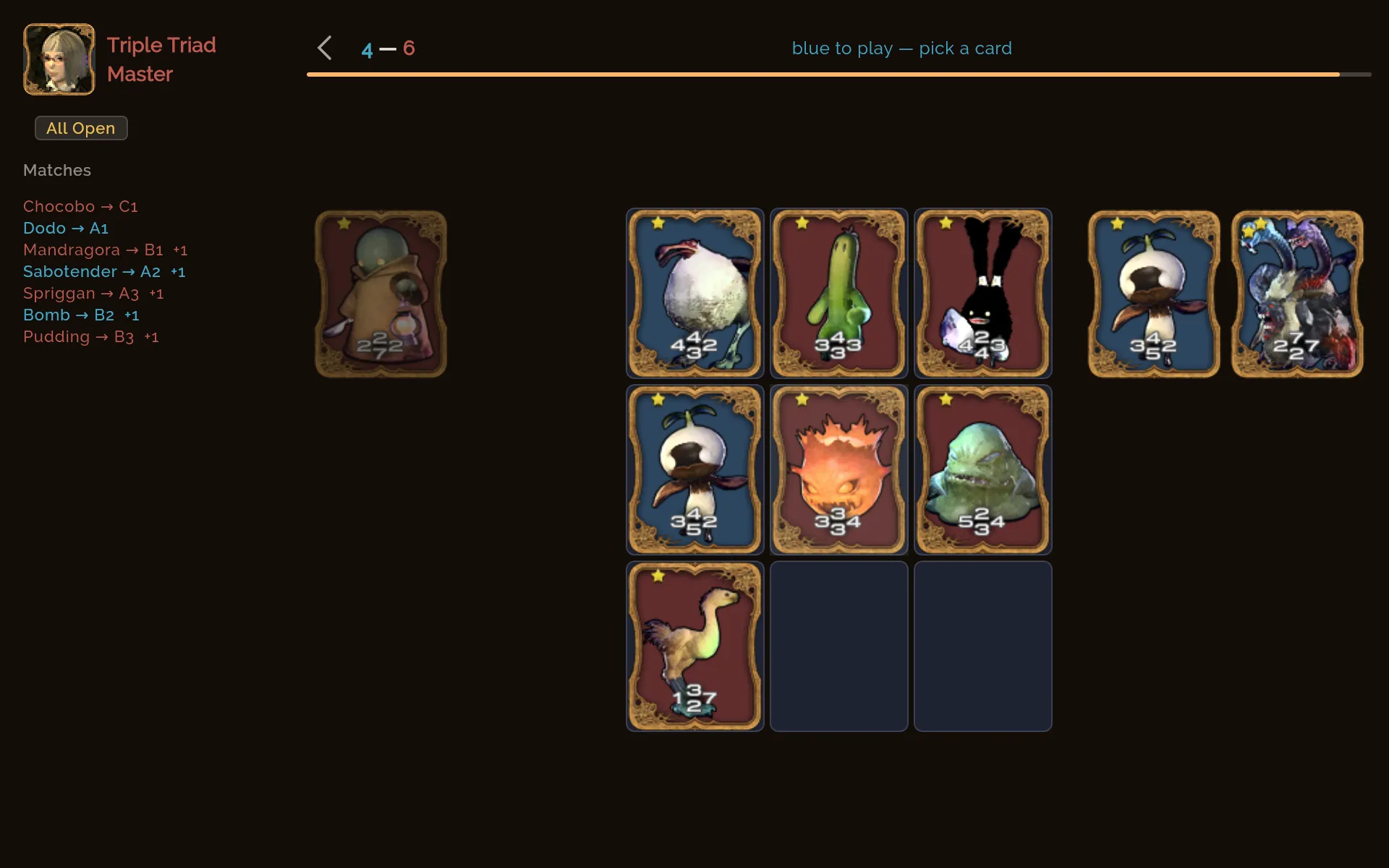
Nine squares, ten cards: the board has not changed since 1999.